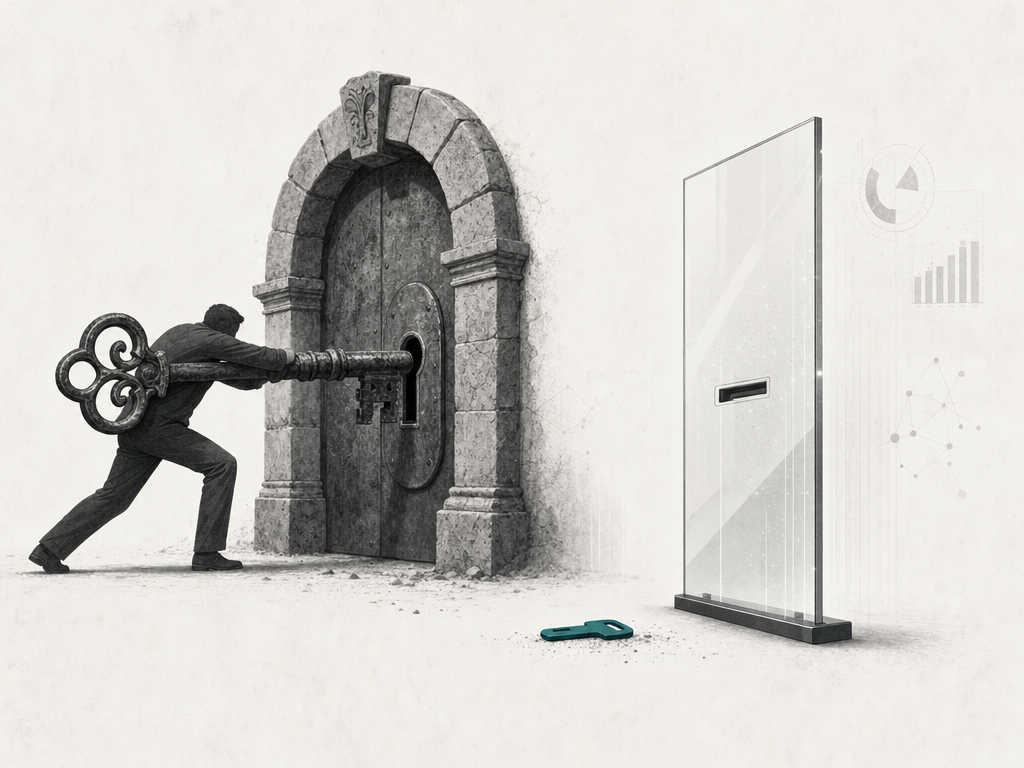

A Free AI Visibility Check runs 10 buyer questions across 2 AI platforms, chosen from ChatGPT, Gemini, Perplexity, Claude or Grok, and structured around five buyer journey themes. Our position: that focused sample is diagnostic, not exhaustive. It will not score your brand across every query a buyer might type, but it shows whether AI assistants describe your company accurately, cite you, or send buyers elsewhere.
Disclosure: the Free AI Visibility Check described in this article is a service AEO Dose offers. The methodology and findings referenced here come from how we run that check. The relationship is worth naming so readers can weigh the examples with that context.
- The plain scope of the check: 10 questions, 2 platforms, no sales call
- How the questions are reverse-engineered from real pharma buyer journeys
- What each of the five buyer journey themes tests for
- The specific gaps the check surfaces for API, CDMO, excipient, nutraceutical and oral care brands
- Why a narrow pharma buyer intent makes 10 questions outperform 100 generic ones
- The limits of a sample and when a full audit is the right move
- The concrete step to take once you see your findings
What the Free Check actually is: 10 questions, 2 platforms, plainly described
The Free AI Visibility Check is a 10-question diagnostic run against 2 AI assistants, typically ChatGPT and either Perplexity or Gemini. No sales call required. We ask the assistants the kinds of questions a real buyer would ask when researching a supplier in your category, then read back exactly what the assistant says about your brand, your competitors, and the gaps between them.
That is the whole mechanism. We are not crawling your site or auditing your schema at this stage. We are doing what your buyer does: asking an AI assistant a procurement-shaped question and recording the answer. The output is a snapshot of how you appear, or fail to appear, when a buyer leans on AI instead of a search engine.
In 2025 that behavior has moved from experimental to routine. Pharma procurement, technical, and sourcing teams now open ChatGPT, Gemini, Perplexity, Claude or Grok before they open a search tab. The Free Check measures what those tools say back.
How the 10 questions are built from real pharma buyer journeys
The 10 questions are reverse-engineered from how pharma buyers actually research suppliers, not from keyword volume. A generic audit starts with a keyword list. Our check starts with a buyer and the decision they are trying to make.
That distinction matters because pharma buyer intent is specific. A formulation scientist sourcing an excipient does not type "best supplier." They ask whether a given supplier has a compendial grade, co-processed options, or a regulatory support file. Our founder, M Netrajit Singha, built this question set drawing on a B.Pharma background and more than 12 years in pharma ERP implementation and Computer System Validation. That grounding is why the questions read like procurement research rather than marketing queries. They reflect the way sourcing, technical, and BD teams phrase things when the answer has regulatory and supply-chain consequences.
Ten questions is a sample. We say that plainly. It is not a census of every phrasing a buyer might use. It is a structured probe designed to hit the decision points that matter.
The five buyer journey themes: discovery, evaluation, product/capability, commercial, support
The 10 questions map to five buyer journey themes: discovery, evaluation, product/capability, commercial, and support. Each theme tests a different moment in how a buyer moves from "I need a supplier" to "I'll contact this one." We treat these as members of one journey, not a ranked hierarchy. Each surfaces a different kind of gap.
| Theme | What it tests |
|---|---|
| Discovery | Whether an assistant names your brand at all when a buyer asks who makes a given product or serves a given category. |
| Evaluation | How you are described when a buyer compares options: are your capabilities stated accurately, or is the answer vague or wrong? |
| Product and capability | Specifics like dosage forms, API classes, grades, and certifications. |
| Commercial | The practical sourcing layer: minimum order quantities, locations, lead expectations, and how a buyer would engage. |
| Support | Whether an assistant can point a buyer toward documentation, regulatory files, or a contact path. |
Read together, the five themes show not just whether you appear, but at which stage of the journey you disappear.
What the check surfaces for API manufacturers, CDMOs, excipient suppliers, nutraceutical and oral care brands
The check surfaces different, business-specific gaps depending on what you make. The mechanism is the same, but the failure points differ by category.
For an API manufacturer, discovery and product questions often reveal whether assistants associate your name with the right API classes and synthetic capabilities, or whether you are simply absent when a buyer asks who supplies a molecule. For a CDMO, evaluation questions expose whether your contract manufacturing scope, dosage forms, and scale are described accurately when a buyer compares organizations. For an excipient supplier, product and capability questions show whether assistants know your grades, co-processed options, and compendial coverage. For a nutraceutical brand, the check often surfaces citation gaps: the assistant may describe your category correctly but not link back to you. For an oral care product manufacturer, discovery questions on Gemini and Perplexity reveal whether you appear in category answers at all.
These are the kinds of category-specific patterns we unpack further in our industry-specific visibility challenges for pharma suppliers cluster, which walks through how each business type tends to appear in AI answers.
Why 10 focused questions outperform 100 generic ones for pharma intent
Ten well-constructed pharma questions outperform 100 generic ones because pharma buyer intent is narrow and theme-specific. Most AEO audits chase keyword volume: more queries, bigger reports, the appearance of thoroughness. That approach is built for broad consumer categories where intent spreads across many phrasings.
Pharma does not work that way. The population of questions a serious buyer asks when sourcing an API, a contract manufacturer, or an excipient is small and structured. A buyer sourcing a solid dose CDMO has a bounded set of concerns: dosage forms, scale, certifications, location, regulatory support. Fire 100 generic queries at that buyer journey and many of them land outside the actual decision. Fire 10 questions built from the real journey and you hit the points where visibility actually converts to an inquiry.
This is the pushback worth stating directly: volume is a proxy for rigor, not rigor itself. For narrow pharma intent, a focused sample reads the signal more cleanly than a high-volume sweep that dilutes it.
What a Free Check cannot tell you and when to go deeper
The Free Check cannot score your visibility comprehensively, and it is not a substitute for the Full Audit. Ten questions on 2 platforms is a probe, not a complete picture. It will not test all five platforms, will not crawl your site, and will not rank every gap by impact and effort.
When the Free Check surfaces a real gap, the next step is the Full Audit. That is where the work moves from "here is a snapshot of a problem" to "here is the ranked, prioritized remediation." The Full Audit widens the platform coverage, examines your website and structured content, and runs the full Audit, Optimize, Build Authority, Measure, Repeat cycle. We describe that scope in detail in our audit and optimization process cluster.
The honest framing: use the Free Check to find out whether you have a visibility problem worth solving. Use the Full Audit to solve it.
What to do with the findings
Run the Free AI Visibility Check this week on your own brand, then read the answers like a buyer would. Note three things: whether the assistant named you at all, whether it described your capabilities accurately, and whether it pointed a buyer toward a way to engage. If any of the three fails, you have a concrete gap to act on, not a vague sense that "AI might matter."
If the snapshot surfaces gaps that span multiple themes or platforms, request the Full Audit to get the ranked remediation. Start with the check.