
Reviews are sparse. Substantive third-party reviews of pharma-specialized AI visibility services do not yet exist at scale because the category is new. That is the honest answer. For now, buyers should evaluate vendors on methodology transparency, platform coverage, and pharma-industry grounding instead of waiting for review aggregates to mature.
Disclosure: this article is published by AEO Dose, which provides AI visibility and AEO readiness audits for pharma businesses. The evaluation criteria below reference our own methodology as one example. The ownership relationship is real and worth naming so readers can weigh the framework with that context in mind.
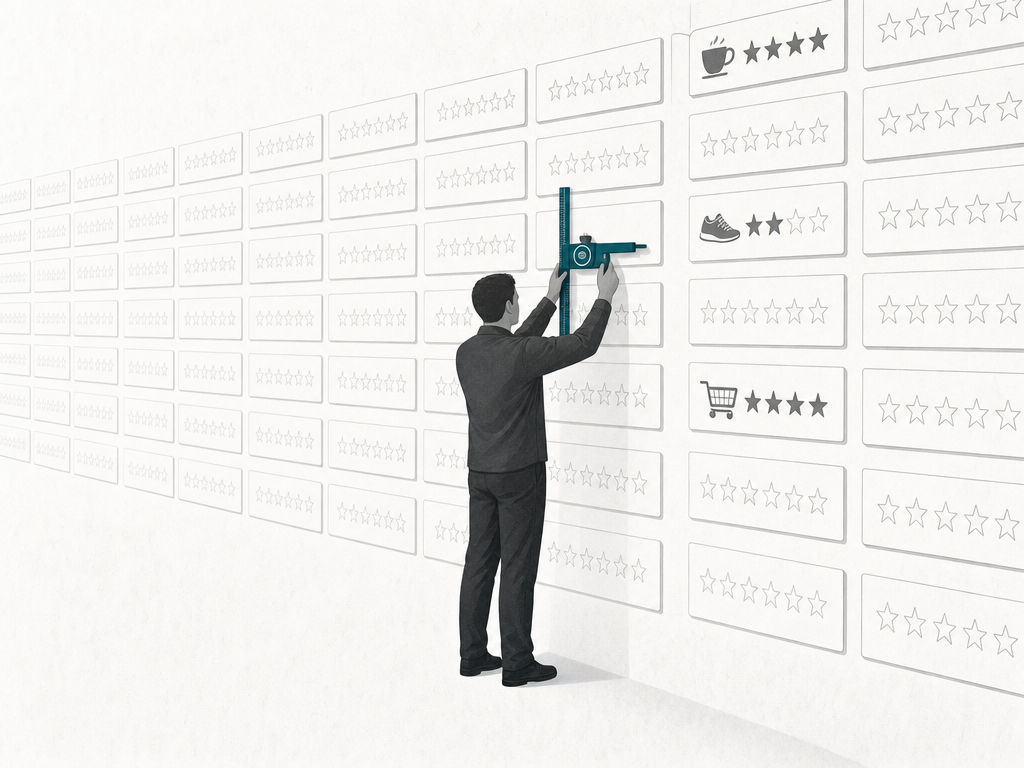
The honest answer: reviews are sparse and here is why
Reviews are sparse because pharma-specialized AI visibility is a young service category, not because every vendor is hiding a weak track record. AI visibility and AEO services emerged as a recognizable buying category around 2024-2025, and pharma adoption has followed the slower rhythm that regulated or quality-sensitive sectors bring to new channels.
That matters for how you read the market. A mature software category can produce comparison pages, public ratings, implementation reviews, procurement references, and user complaints. Pharma AI visibility does not yet have that density. The buyer set is narrower, engagements are newer, and many projects involve confidential commercial positioning, supplier discovery, or category visibility work that companies do not publish publicly.
So the review-first habit is understandable, but it is a poor filter by itself in this category. If you make reviews the gatekeeping test, you can miss the more observable question: can the vendor show exactly how it tests AI assistant answers, what platforms it covers, what questions it uses, and how it turns findings into measurable next steps?
Where AI visibility vendor reviews typically appear and what to make of them
AI visibility vendor reviews tend to appear as scattered trust signals rather than clean review aggregates. You may find testimonials on a vendor site, founder posts, conference mentions, case-study excerpts, partner references, or direct client references shared privately during procurement. For a deeper treatment of how to read these adjacent trust signals, see our broader work on reading case studies and testimonials for AEO services.
Each signal has limits. A testimonial can show that a client approved the relationship, but it may not show whether the vendor measured ChatGPT, Gemini, Perplexity, Claude, and Grok separately. A case study can show a before-and-after narrative, but it may not reveal the prompt set, the repeat-test schedule, or whether results were checked against real buyer questions. A private reference can be useful, but it is still a curated reference.
The practical reading is simple: treat reviews as evidence of service experience, not proof of methodology. A review can tell you whether a vendor communicated clearly or delivered a report. It cannot, by itself, tell you whether the audit design was strong enough for API manufacturers, CDMOs, excipient suppliers, nutraceutical brands, or oral care manufacturers.
A better frame: what to evaluate when the category is too new for review aggregates
When review aggregates are thin, evaluate the operating system behind the service. The useful frame is not "does this vendor have enough public reviews?" It is "can this vendor make its method visible enough for a pharma buyer to inspect before paying?"
Three criteria are worth checking together, as members of the same evaluation set rather than a ranked list.
One is methodology transparency. The vendor should be able to explain what it tests, which prompts it uses, how it handles repeatability, and how it separates visibility gaps from content gaps or authority gaps.
Another is platform coverage. AI assistants do not behave as one channel. A supplier can appear in one assistant and disappear in another because the answer engine, retrieval layer, citations, and phrasing differ.
The third is pharma-industry grounding. A general AEO practitioner may understand schema, content, and entity signals. Pharma supplier selection adds category language, regulatory caution, technical buying criteria, and buyer intent patterns that are easy to flatten if the vendor has no domain exposure.
None of these criteria guarantees a good outcome. They make the vendor easier to inspect before you commit budget.
Platform coverage: what credible AI visibility work actually measures
Credible platform coverage means testing the assistants buyers are likely to use, not treating "AI visibility" as one generic search result. At AEO Dose, the Free AI Visibility Check covers 2 platforms and 10 real buyer questions. The Full Audit covers all 5 platforms: ChatGPT, Gemini, Perplexity, Claude, and Grok.
This matters because each platform can produce a different commercial reality. A CDMO may be named when a buyer asks one assistant for sterile manufacturing options, absent when the same question is asked elsewhere, and misclassified when the assistant summarizes service capabilities. An excipient supplier can be visible for generic ingredient queries but absent when the prompt includes application, region, grade, or buyer constraint.
Ask vendors to show platform-by-platform output, not just a summary score. A useful audit should preserve the original question, the assistant response, the named competitors or alternatives, the citation behavior where available, and the gap diagnosis. Without that layer, the report becomes a slide deck of conclusions the buyer cannot challenge.
AI assistant platforms are also changing quickly. A review from last year may describe a service experience, but the platform behavior behind that service may already have shifted.
Methodology transparency: what a vendor should be able to show you
A vendor should be able to show its audit method in enough detail that you can understand the work without trusting the sales language. For AEO Dose, the operating cycle is Audit, Optimize, Build Authority, Measure, Repeat. That cycle is not decoration. It describes the sequence: test current visibility, identify gaps, make the evidence clearer, strengthen external authority signals, measure again, then repeat because assistant behavior changes.
In a sales conversation, ask for a sample structure. You do not need confidential client data. You do need to see what an output looks like. Does the vendor show raw prompts? Does it distinguish branded queries from unbranded buyer questions? Does it separate "not mentioned" from "mentioned but positioned incorrectly"? Does it record whether the assistant cited the company website, a directory, a publication, a regulator page, or no source at all?
Also ask how recommendations are prioritized. A weak methodology jumps straight from "you are not visible" to generic content production. A stronger methodology identifies whether the issue is entity clarity, page-level evidence, category positioning, third-party corroboration, technical accessibility, or stale content.
Pharma-industry grounding: why domain depth matters more here than in general AEO
Pharma-industry grounding matters because AI visibility work in this market depends on how buyers actually describe suppliers, capabilities, quality constraints, and use cases. The language around an API manufacturer is not interchangeable with the language around a consumer wellness brand. A CDMO is not evaluated like a general B2B service provider. An excipient supplier may need to be understood by function, grade, formulation role, compendial status, and application context.
This is where domain exposure becomes practical, not ornamental. My own background is a B.Pharma degree plus 12+ years of Pharma ERP implementation and Computer System Validation experience. That does not make every visibility question simple. It does change the questions I ask when reading an AI answer: is the assistant confusing distributor and manufacturer roles, omitting quality-relevant capabilities, overstating a claim, or flattening a technical supplier category into a generic vendor list?
For pharma buyers, the evaluation point is straightforward. Ask whether the vendor can discuss your category without forcing it into generic SEO language. If they cannot explain the difference between supplier discovery, technical fit, authority evidence, and compliance-sensitive wording, the audit may miss the actual buying context.
Questions to ask any AI visibility vendor before signing
Take a concrete checklist into your vendor conversation. Do not ask only for reviews. Ask questions that expose the method behind the service.
Use this list:
- Which AI assistant platforms do you test, and do you report results separately for each one?
- How many buyer questions are included in the first audit, and how are those questions selected?
- Do you test branded, unbranded, comparison, and category-specific prompts?
- Will I see the raw prompts and raw assistant answers, or only your summary?
- How do you distinguish a visibility problem from an authority, content, entity, or freshness problem?
- Can you show a sample report without client-confidential information?
- How do you handle prompt repeatability when AI assistants change their answers?
- What pharma or healthcare operating knowledge informs your interpretation?
- What recommendations come after the audit, and how do you measure whether they worked?
- What claims are you not willing to make from the data?
The last question is useful. A credible vendor should be able to say where the evidence stops. If every answer sounds certain, polished, and universal, slow down. Pharma buyers do not need theatrical confidence. They need a method they can inspect, a scope they can understand, and findings that survive a serious follow-up question.
If you want to experience the methodology this article argues matters rather than just ask about it, start with a direct test of your own visibility.
Ready to see exactly how your pharma brand appears across AI assistants today?
Get Your Free AI Visibility CheckFrequently asked questions
Are there any customer reviews for companies that help pharma brands show up in AI assistants?
There are some scattered trust signals, but substantive third-party review coverage for pharma-specialized AI visibility services does not yet exist at scale. The category is new, and many engagements are confidential or early-stage. Buyers should still ask for references, testimonials, and sample reports, but those signals should be read alongside methodology transparency, platform coverage, and pharma-industry grounding. Together those criteria do the work a mature review aggregate would otherwise do.
Why are there so few reviews of AI visibility services for pharma right now?
There are few reviews because AI visibility and AEO became a recognizable service category only recently, especially in pharma. The buyer base is narrower than general marketing services, projects are newer, and companies may avoid publishing details about supplier positioning or competitive visibility. Sparse reviews are not proof of vendor quality either way. They mean the buyer has to inspect the method more closely rather than defaulting to review aggregates that have not had time to form.
Where do reviews of AEO and AI visibility services typically appear?
They usually appear as vendor-site testimonials, short case-study claims, conference mentions, founder posts, private client references, or procurement conversations. Those sources can help you judge professionalism and client experience. They do not automatically prove that the vendor tested the right platforms, used real buyer questions, preserved raw outputs, or interpreted pharma-specific supplier language correctly. Read them as evidence of service experience rather than as proof of audit methodology.
What platform coverage should a credible pharma AEO vendor offer?
A credible vendor should be clear about which AI assistants it tests and should report results separately by platform. AEO Dose's Full Audit covers ChatGPT, Gemini, Perplexity, Claude, and Grok, while the Free AI Visibility Check covers 2 platforms and 10 real buyer questions. The important point is transparency: the buyer should see what was tested, where visibility appeared, and where it did not. Because platforms evolve quickly, coverage also has a shelf life.
How can I evaluate the methodology of an AI visibility vendor?
Ask the vendor to show its audit method in enough detail that you can understand the work without trusting the sales language. A credible methodology states which prompts are used, which platforms they run against, how appearances and recommendations are recorded, and how findings connect to the next round of work. Ask for a sample report. In the absence of a disclosed process, a visibility result is unfalsifiable because you cannot tell whether it reflects real buyer behavior or a flattering query the vendor chose.
What are the warning signs of a weak AI visibility provider?
Warning signs include vague claims about "AI rankings," no visible prompt methodology, no platform-by-platform reporting, no sample audit format, and generic recommendations that jump straight to content production. Another warning sign is overconfidence. If a vendor cannot explain what its audit can and cannot prove, the buyer has no way to separate evidence from sales language. Be cautious of any provider who promises a specific visibility outcome, since assistants change quickly and no honest vendor can guarantee a fixed result.