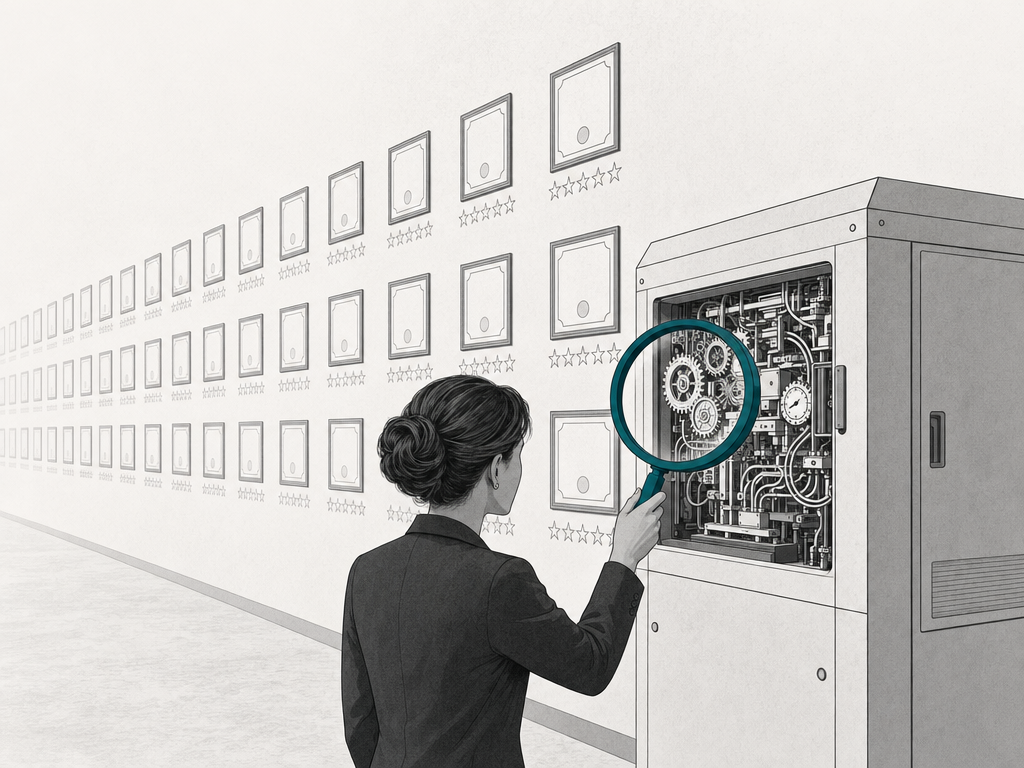
Pharma companies that engage an AI visibility audit consistently find three recurring categories of gaps: citation absence on real buyer questions, inaccurate AI-generated descriptions of their business, and competitor citations on queries where they have stronger credentials. AEO Dose tests this across ChatGPT, Gemini, Perplexity, Claude, and Grok, using buyer-journey questions rather than vanity prompts. Below are the patterns, mechanisms, and limits, without invented case studies or outcome claims.
What pharma companies expect from an AEO audit versus what they find
The expectation is a visibility score, but the reality is a diagnostic of how AI assistants understand, ignore, or misdescribe the business. That distinction matters because the audit is not a new version of an SEO rank report. It tests what happens when a buyer asks a decision-oriented question.
A wrong expectation sounds like this: "Tell us whether we appear in ChatGPT." The useful question is sharper: "When a procurement, formulation, sourcing, brand, or business development user asks for a supplier comparison, does the AI assistant name us, describe us correctly, and cite evidence that reflects our real capabilities?"
That is where API manufacturers, CDMOs, excipient suppliers, nutraceutical brands, and oral care brands get a more concrete experience than they expected. The audit does not return a generic recommendation to write more content. It shows the question, the platform response, the entities cited, the competitor names surfaced, and the description the model generated.
The surprise is operational. A site can look professionally built and still be unclear to AI systems. A company can have strong manufacturing capability and still be absent from discovery questions. A supplier can have credible documentation and still be described with outdated, incomplete, or over-broad language.
In audits run over the past year, the useful conversation has been less about "AI strategy" and more about evidence trails: which pages, third-party references, product descriptions, capability statements, and entity signals support the answer the assistant gives.
The three recurring gap categories we see across audits
The audit findings fall into three recurring categories: absence from cited answers, inaccurate business descriptions, and competitor citations where the client has stronger operational credentials. These are not ranked categories. They are different failure modes with different repair paths.
Citation absence appears when an AI assistant answers a real buyer question but does not mention the company. For an API manufacturer, that question may involve supplier discovery for a specific therapeutic category or manufacturing capability. For a CDMO, it may involve dosage form, scale, regulatory support, or geography. For an excipient supplier, it may involve function, application, grade, or documentation.
Inaccurate description is a different problem. The assistant may mention the company but describe it too broadly, too narrowly, or with old positioning. A nutraceutical brand may be treated as a general wellness seller when the buyer question is about formulation evidence, certifications, or delivery format. An oral care manufacturer may be described as a consumer brand when the commercial relevance is contract manufacturing, private label capability, or category-specific production.
Competitor citation on strong-credential queries is the third pattern. This happens when the client has evidence that should make them relevant to the query, but AI assistants cite competitors when those competitors have clearer public evidence, cleaner entity signals, or better crawlable explanations. That is wasted budget if the response is to publish random blog content. The fix starts by mapping the missing evidence layer to the exact query where the gap appeared.
AEO Dose's audit process groups prompts into five buyer-journey themes: discovery, evaluation, product/capability, commercial, and support. That structure keeps the findings tied to buying behavior instead of abstract prompt testing.
What the audit experience looks like week by week
A practical audit moves from question design to platform testing to evidence diagnosis to prioritized fixes. From the client side, the work feels closer to a commercial and content evidence review than to a traditional website audit.
In the first stage, the team defines the buyer questions. This is not a keyword export. For API manufacturers, the questions may include supplier discovery, impurity support, regulatory documentation, and molecule-category relevance. For CDMOs, the questions may cover dosage form, scale, development stage, tech transfer, and geography. For excipient suppliers, the questions may test function, grade, compatibility, and formulation use. Nutraceutical and oral care audits add category, claim, format, private label, and distribution questions.
The next stage tests those questions across ChatGPT, Gemini, Perplexity, Claude, and Grok. The audit records whether the company appears, how it is described, which competitors appear, and what evidence the assistant seems to rely on. The point is not to reverse-engineer one model. The point is to see how multiple assistants behave when facing realistic buyer intent.
The third stage diagnoses why the answer looks the way it does. This is where pharma operational context matters. My background as a B.Pharma graduate with more than 12 years in Pharma ERP implementation and Computer System Validation shapes how I read these gaps. A missing mention is not only a content issue. It may reflect unclear capability architecture, weak product taxonomy, poor document discoverability, ambiguous facility information, or no credible third-party reinforcement.
The final stage turns findings into an action sequence. A useful report tells the team which evidence needs to exist, which pages need clarification, which entity profiles need consistency, and which buyer questions should be retested after changes.
How findings differ across API manufacturers, CDMOs, excipient suppliers, nutraceutical brands, and oral care brands
The same audit framework produces different findings because each segment is evaluated through different buyer questions and evidence expectations. Treating all five as "pharma companies" hides the actual work.
For API manufacturers, gaps appear around molecule relevance, manufacturing credibility, regulatory support, documentation, and buyer confidence. If public pages do not connect the API, capability, facility, and evidence in a clear way, AI assistants have less material to cite.
For CDMOs, the issue is capability specificity. "Contract manufacturing" is too broad for AI answers that need to compare dosage form, batch scale, development phase, technical services, regulatory history, or region. A CDMO may be operationally strong but still look generic if its website does not expose the structure buyers use to shortlist partners.
Excipient suppliers face a different evidence problem. AI assistants need to understand function, grade, application, formulation relevance, and compliance context. If the page only lists product names without use-case explanation, the assistant may not connect the supplier to the buyer's formulation question.
Nutraceutical brands are tested against product format, claims, ingredient evidence, certifications, distribution, and brand trust. Weakness appears when public information reads like consumer marketing but the AI question requires verifiable substance.
Oral care brands and manufacturers face a split identity problem. The assistant may need to distinguish branded products, private label manufacturing, formulation capability, category specialization, and distribution. If those roles are not separated cleanly, the answer can collapse them into one vague description.
The buyer questions that reveal the biggest visibility gaps
The revealing questions are the ones a real buyer would ask when narrowing options, not broad brand-awareness prompts. "Tell me about Company X" is less useful than a question that asks an assistant to recommend, compare, or shortlist suppliers under constraints.
Discovery questions test whether the company enters the conversation at all. Examples include supplier discovery for a category, dosage form, ingredient type, region, or capability. If the company is absent here, the buyer may never see it in the AI-assisted research path.
Evaluation questions test whether the assistant can compare the company accurately. These questions expose whether the model understands the company's role, capabilities, and evidence. An inaccurate answer here can be more damaging than no answer because it gives the buyer a false reason to exclude the company.
Product and capability questions test technical clarity. For an API manufacturer, the assistant may need to connect molecules, manufacturing, documentation, and compliance. For a CDMO, it may need to connect formulation, scale, and service model. For an excipient supplier, it may need function and application context.
Commercial questions test whether the business model is clear. Does the company sell direct? Does it manufacture for others? Does it support private label? Does it serve regulated export markets? Support questions test documentation, contact paths, technical assistance, and post-shortlisting confidence.
These questions reveal gaps because they force the assistant to assemble an answer from available evidence. If the evidence is thin, scattered, inconsistent, or not aligned with how buyers ask, the answer degrades.
What pharma companies do with findings in the first 90 days
The first 90 days are best used to repair evidence gaps, clarify entity signals, and retest the same buyer questions after changes. This is not the time for unfocused content production.
The first action is triage. Teams separate findings into three practical groups: missing evidence, unclear evidence, and external reinforcement gaps. Missing evidence means the buyer question has no strong page or document to support the answer. Unclear evidence means the information exists but is buried, vague, duplicated, or written for internal language rather than buyer language. External reinforcement gaps mean the company lacks consistent third-party profiles, directory references, or public entity signals that support its claims.
The second action is ownership. Marketing may own website copy, but business development may understand buyer questions better. Regulatory, QA, technical, and product teams may need to validate descriptions. For CDMOs, API manufacturers, excipient suppliers, nutraceutical brands, and oral care brands, AEO work becomes practical only when the evidence is checked by people who understand the operation.
The third action is provider scrutiny. When a team starts evaluating a provider's credibility, it should ask how the provider designs prompts, records outputs, handles platform differences, avoids outcome promises, and turns findings into specific fixes. The Checking Reviews for AI Services cluster is the right next stop if you want to frame those evaluation questions before choosing support.
The fourth action is retesting. The same discovery, evaluation, product/capability, commercial, and support questions should be run again after priority changes are published and indexed. The useful measure is not whether a dashboard looks better. It is whether the assistant's answer becomes more accurate, better supported, and more aligned with the company's real buyer relevance.
Honest expectations and limits of this work
An AEO audit can show what AI assistants currently say, but it cannot guarantee future citations or control model behavior. That limit should be stated plainly before budget is assigned.
The work is valuable because it makes the gap visible. It shows where ChatGPT, Gemini, Perplexity, Claude, and Grok mention the company, omit it, misdescribe it, or prefer competitors. It also shows which buyer-journey theme is affected: discovery, evaluation, product/capability, commercial, or support. That is a practical starting point.
The work has limits because AI platforms change, retrieval behavior varies, and public evidence is only one layer of the answer environment. AEO is not a switch. It is a disciplined process of making the business more understandable, verifiable, and citeable for the questions buyers are already asking.
For pharma and healthcare businesses, the correct expectation is not instant uplift. The correct expectation is a sharper view of where public evidence fails to represent the operation. From there, the work becomes specific: clarify capability pages, strengthen product and service descriptions, align entity profiles, improve third-party consistency, and retest the same buyer questions.
If you want a low-commitment first view, run a small check before commissioning a full audit: Get Your Free AI Visibility Check
Get Your Free AI Visibility Check