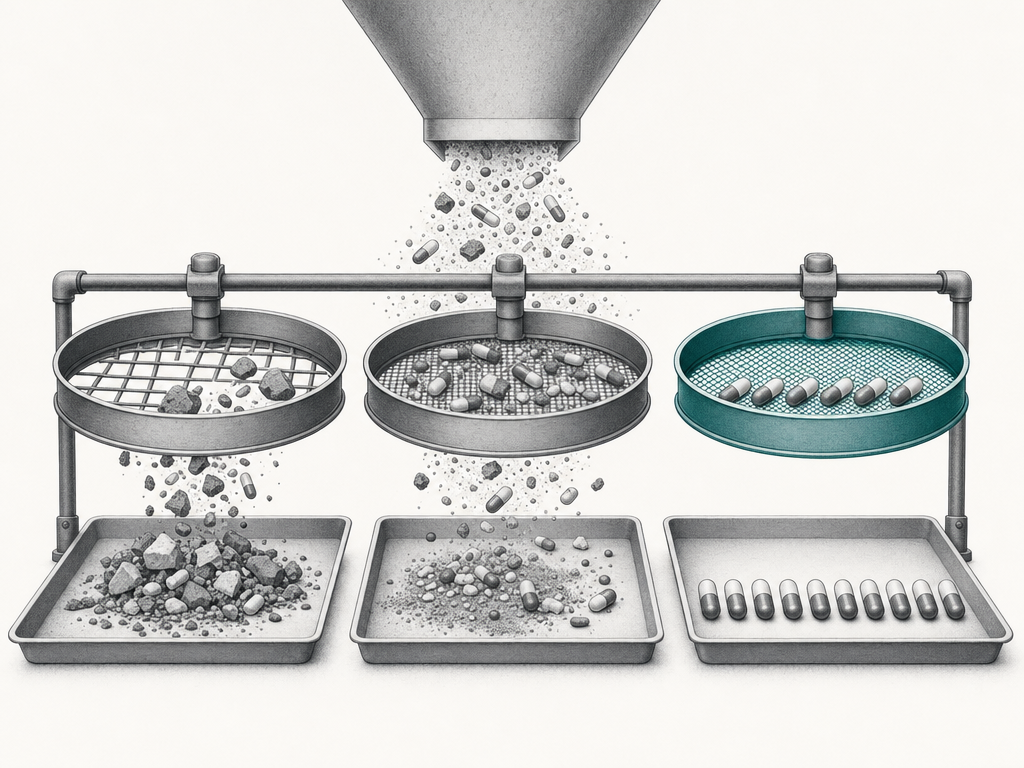
What features do AI visibility optimization tools offer for pharma brands, and which actually matter? Feature count is the wrong unit of comparison. Two categories determine whether a tool produces anything actionable: platform coverage across the AI assistants your buyers actually use, and whether the tool tests real pharma buyer questions instead of generic keyword lists. This article explains why the checklist framing fails and what to evaluate instead.
Why the feature-checklist is the wrong question
The feature checklist is the wrong question because two tools with identical feature lists can produce completely different findings for a pharma brand. A pharma marketing lead evaluating software usually opens a comparison grid: dashboards, number of tracked prompts, export formats, sentiment scoring, competitor benchmarking. That grid tells you what the tool does. It does not tell you whether the tool is looking at the right questions on the right platforms, which is what determines whether the output is useful or decorative.
Here is the reframe. If a tool tracks 500 prompts but none of them resemble how an API buyer asks about capacity, you have a tool with an impressive feature list and no relevant data. If a tool monitors three platforms but your buyers are comparing suppliers in Perplexity and Claude, the dashboard is clean and wrong. Feature count is easy to compare and easy to inflate. The two things that change outcomes are harder to put on a grid, which is exactly why the grid misleads.
Most generic AEO tools were built for consumer brands and general B2B. That is not a criticism of their engineering. It means their default assumptions about buyer language and platform mix do not transfer to a CDMO or an excipient supplier without work. The AI optimization tools category is broad, and you can see the range across the Exploring AI Optimization Tools cluster. The point is to evaluate the category by mechanism, not by feature count.
What AI visibility tools actually offer
AI visibility tools typically cluster into a handful of feature categories regardless of vendor. Understanding the categories helps you separate what is standard plumbing from what actually varies between tools.
The common categories are: prompt tracking (the tool runs a set of questions against one or more AI assistants and records whether your brand appears), citation and source analysis (which pages or domains the assistant pulled from), competitor or share-of-answer comparison, sentiment or tone scoring, historical trend tracking, and alerting or reporting. Some tools crawl search results and infer AI behavior. Others run scheduled prompts directly against the assistants and capture live answers.
These categories tend to show up on vendor comparison pages as distinct selling points. In practice, prompt tracking and reporting are table stakes. The categories that genuinely vary, and that determine whether the output maps to your buyers, are which platforms get tested and where the tested questions come from. Those two sit underneath almost every other feature, because a sentiment score on an irrelevant question is still irrelevant.
Platform coverage: which assistants the tool tests
Platform coverage matters because an AI visibility tool can only report on the assistants it actually queries. If the tool does not test Claude, it cannot tell you how you appear in Claude. This sounds obvious, yet it is a dimension where tool coverage genuinely varies across the category.
As of early 2025, the assistants that show up in pharma supplier research are ChatGPT, Gemini, Perplexity, Claude, and Grok. Each behaves differently. Perplexity leans on live citations and surfaces source domains, which matters when a procurement researcher is checking whether your DMF availability is documented somewhere credible. ChatGPT and Claude synthesize from training and connected search in ways that reward entity consistency. Gemini pulls from Google's index differently again. When a tool tests only two platforms, it is giving you a partial map and presenting it as complete.
For pharma specifically, buyer behavior has shifted enough that AI assistant discovery is a current channel, not a hypothetical one. Sourcing teams ask an assistant to shortlist CDMOs with a given capability before they ever open a vendor directory. A note on dates: this five-platform set reflects the 2025-2026 landscape and may shift as new assistants enter the pharma buyer workflow. Evaluate coverage against where your buyers are now, not against an older three-platform snapshot.
Question source: generic keywords versus real buyer questions
Question source matters because the questions a tool tests determine whether its findings describe your buyers or a generic market. A tool that generates prompts from keyword volume will test things like "best excipient supplier." A pharma buyer rarely asks that. They ask whether a supplier can meet a specific API capacity at commercial scale, whether a CDMO handles a particular dosage form under GMP, or how two excipient grades compare for a formulation constraint.
This is where my background shapes the view. As a B.Pharma graduate with twelve-plus years in pharma ERP implementation and computer system validation, I have watched supplier qualification happen in real purchasing workflows. The vocabulary is specific: API capacity, GMP compliance status, DMF availability, excipient grade qualification, regulatory support for a target market. These terms are not interchangeable with generic B2B phrasing, and a query set built from search volume will not reliably contain them.
So the test for any tool is simple. Ask how it builds its question library. If the answer is keyword research or an auto-generated prompt set, you are getting generic coverage. If the tool starts from the actual buyer journey, from discovery through evaluation to commercial and support, you are closer to questions your buyers would recognize. Continuous monitoring compounds this: a tool rerunning the wrong questions on a schedule just produces a tidy trend line of irrelevant data. The distinction between a one-time audit and ongoing monitoring only helps if the underlying questions are right, a point worth weighing against the broader AI optimization tools landscape.
Methodology and reporting: what separates signal from theater
Methodology separates signal from theater when the reporting ties every finding back to a question a real buyer would ask and a platform a real buyer would use. A dashboard full of scores feels like insight. It becomes insight only when you can trace a score to a specific question, a specific platform, and a specific reason your brand did or did not appear.
Theater looks like this: a single aggregate "visibility score," no visibility into which prompts were run, sentiment scoring with no link to a buyer decision, and competitor comparisons against companies you do not actually compete with. Signal looks like this: the exact questions tested, the platform each was tested on, the answer the assistant gave, which sources it cited, and a clear line from that to an action you can take on your own content and entity presence.
For regulated industries the reporting bar is higher, because a finding that cannot be traced is a finding you cannot act on or defend internally. Ask whether the tool shows you the raw answers, not just the derived scores.
How AEO Dose approaches these requirements
AEO Dose applies the two categories above directly: full platform coverage and a pharma-specific question source. The audit methodology tests all five assistants, ChatGPT, Gemini, Perplexity, Claude, and Grok, rather than a two-platform subset. Questions are organized across five buyer journey themes, discovery, evaluation, product and capability, commercial, and support, using real buyer questions rather than keyword lists.
That design follows from the reframe, not the other way around. The question library uses pharma supplier vocabulary, API capacity, GMP compliance, DMF availability, excipient grade qualification, because generic query sets do not reliably contain those terms. I describe this not to position it as the only valid approach. Any tool that tests the platforms your buyers use, with questions your buyers would recognize, and reports traceable findings, is doing the work that matters. The checklist below lets you check that for yourself.
A checklist you can apply this week
Run any tool you are evaluating through these questions this week:
- Which AI assistants does it test, by name? Confirm it covers the five your buyers use, not a two-platform subset.
- Where do its questions come from? Ask to see the actual prompts. If they come from keyword volume, they will miss pharma buyer language.
- Does the question set contain pharma supplier terms? Look for API capacity, GMP, DMF, excipient grade qualification, dosage form capability.
- Are findings traceable? You should see the exact question, the platform, the raw answer, and the cited sources, not just an aggregate score.
- Does it map to the buyer journey? Coverage should span discovery through commercial and support, not one stage.
- Does continuous monitoring rerun relevant questions, or just produce a trend line of generic ones?
If a tool fails items one through three, feature count will not save it. To see how your brand currently appears across platforms and real buyer questions before you commit to any tool, Get Your Free AI Visibility Check.