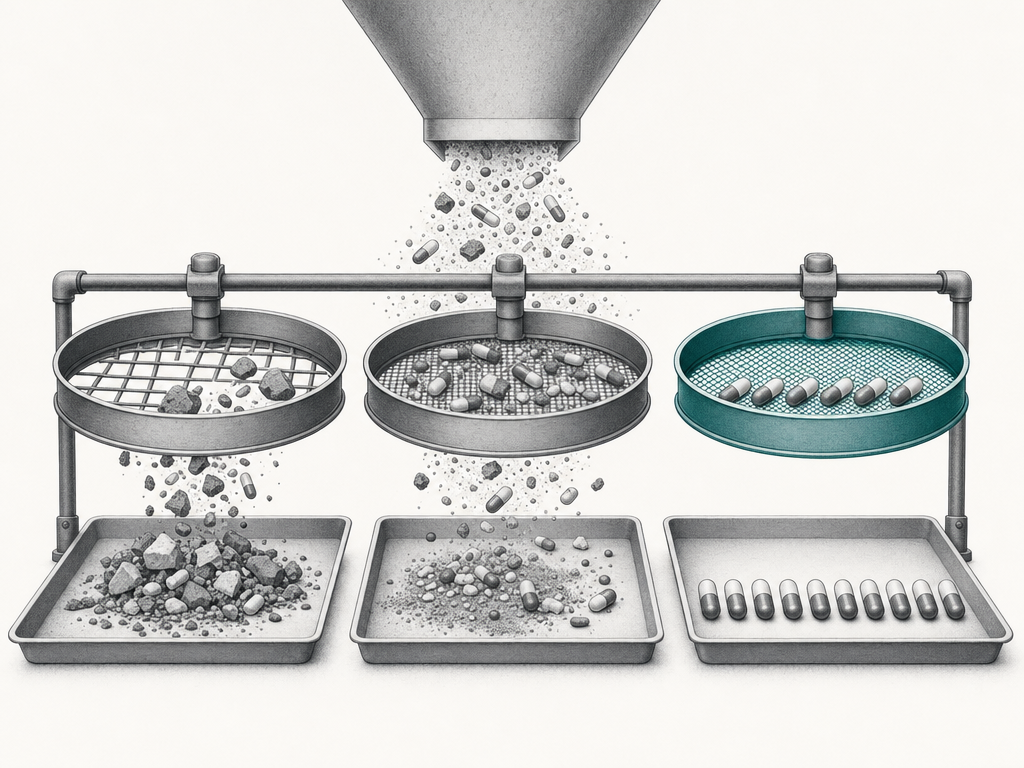
For a small pharmaceutical company, the best AI visibility tool in the first year is a scoped audit methodology across the five platforms your buyers use: ChatGPT, Gemini, Perplexity, Claude, and Grok. It beats a generic subscription because tools surface data without interpreting it against pharma buyer journeys. Our Free Check tests 2 platforms with 10 buyer questions; our Full Audit covers all 5.
What you'll learn
- What a small pharma team actually finds when they go tool shopping
- Why generic monitoring dashboards miss pharma buyer questions
- What a genuinely useful pharma tool would need to do
- Whether software or methodology should come first for a lean team
- The five platforms and the question types worth testing on each
- A phase-by-phase 90-day plan a lean team can execute
- The lowest-friction way to start this week
What small pharma companies actually find when they search for AI visibility tools
A small pharma marketing lead who searches for AI visibility tools finds a market built for consumer brands and large B2B SaaS, not for API manufacturers, CDMOs, excipient suppliers, or nutraceutical makers. The dashboards look polished. They track brand mentions across chat assistants, score sentiment, and plot trend lines. What they do not do is ask the questions a procurement manager at a generics company types into ChatGPT when sourcing a stable excipient at a given grade.
Most AI visibility tools are built for consumer brands, and that shows up in the sample queries they run by default. You get a dashboard that monitors "brand reputation" and "share of voice" against competitors you did not pick, measured on prompts your buyers never ask. For a lean pharma team, that is a subscription cost attached to data that does not map to how a supplier gets shortlisted.
The second thing a small team finds is pricing built for marketing departments with headcount. The tools assume someone will log in weekly, read the dashboard, and translate signals into action. Most lean pharma teams do not have dedicated SEO staff, let alone someone whose job is to interpret an AI monitoring feed.
Why generic AI monitoring tools underperform for pharma buyer journeys
Generic AI monitoring tools underperform for pharma because they measure presence, not relevance to a buyer decision. A dashboard can tell you your brand was mentioned in an answer. It cannot tell you whether the mention appeared when a formulation scientist asked for a CDMO capable of handling a specific dosage form, which is the moment that decides whether you make the shortlist.
Pharma buyer journeys are specific. A buyer evaluating an API supplier cares about regulatory filings, impurity profiles, and documented capacity. A buyer evaluating a CDMO cares about dosage form experience and tech transfer track record. Generic monitoring dashboards sample queries that pharma buyers never ask, so the data they return is confident and beside the point.
My background is a B.Pharma degree followed by twelve-plus years in pharma ERP implementation and computer system validation. That work was about how pharma organizations actually evaluate and qualify suppliers: the documents they demand, the questions they ask, the checks they run before a name goes on an approved vendor list. When a site lacks structured product capability pages, or has no clear answer to a grade-and-specification question, no monitoring dashboard will surface that gap. It will only report that you were, or were not, mentioned.
What a tool for small pharma companies would need to do (and why most do not)
A tool built for small pharma would need to start from real buyer questions and test them against the platforms buyers use, then interpret the gaps against how pharma procurement works. That is a different design brief from a monitoring dashboard, and it is why most existing tools do not do it.
Here is where I will push back on my own industry. The default move in this space is to sell software, because software scales and recurs. But a monitoring subscription answers "am I mentioned" when a small pharma company first needs to answer "when a buyer asks the question that would qualify me, do I show up, and if not, what on my site is missing." That second question is a methodology problem before it is a software problem. Selling a dashboard to a lean team that has not yet diagnosed its gaps is selling a thermometer to someone who needs a diagnosis.
A genuinely useful tool would do three things most do not. It would scope test questions to the buyer's actual sourcing journey rather than reputation metrics. It would run those questions across the specific platforms that matter now. And it would read the results against pharma-specific content gaps, not generic SEO signals. If you want to go deeper on how these tool categories differ, the Exploring AI Optimization Tools cluster covers monitoring, auditing, and content optimization approaches.
Methodology vs software: which should come first for a lean team
For a lean team, methodology comes first and software comes second, if at all. The reason is sequencing: you cannot usefully monitor a position you have not yet measured, and you cannot fix gaps a monitoring feed does not diagnose. A scoped audit tells you where you stand and what to change. Ongoing software then tracks whether your changes moved anything.
This is not an argument that monitoring software is useless. Once a company has run a diagnostic, defined its priority buyer questions, and made content changes, a monitoring tool can be a reasonable way to watch for drift across platforms. The error is treating the subscription as the starting point. For a small pharma company with limited budget and no dedicated SEO staff, a one-time scoped audit produces a prioritized action list. A software subscription produces a recurring charge and a dashboard someone still has to interpret.
The practical question for a lean team is not "which tool," it is "what do I need to know first, and how do I know it with the least overhead."
The five platforms that matter and the question types to test on each
The five platforms worth testing in 2026 are ChatGPT, Gemini, Perplexity, Claude, and Grok, and each plays a role in how a pharma buyer might discover or evaluate a supplier. I am not ranking them. Buyers use different assistants for different habits, and a supplier can be well cited on one and absent on another, so the useful scope is all five rather than a favorite.
The question types matter as much as the platforms. At AEO Dose we scope test questions across five buyer journey themes, and each theme tests a different mechanism:
| Buyer journey theme | What this actually tests | Where it applies |
|---|---|---|
| Discovery | Whether you appear when a buyer asks an open sourcing question | When a buyer does not yet know your name and asks for suppliers of a category |
| Evaluation | Whether you appear in comparisons against named competitors | When a buyer is shortlisting and asking an assistant to compare options |
| Product / capability | Whether a grade, specification, or dosage form query returns you | When a buyer has a specific technical requirement to match |
| Commercial | Whether sourcing, MOQ, or supply questions surface you | When a buyer is testing commercial fit before contact |
| Support | Whether documentation, regulatory, or qualification queries find you | When a buyer checks whether you can support their compliance needs |
The Free Check runs 10 real buyer questions on 2 platforms, which is enough to show a team whether they have a visibility problem at all. The Full Audit runs all 5 platforms across all 5 themes, which is what you need before you decide what to fix.
What the first 90 days should look like for a small pharma marketing lead
The first 90 days should move from diagnosis to targeted fixes to a first re-test, in three roughly equal phases a lean team can run without new headcount.
Diagnose. Pick ten to fifteen real buyer questions your sales team actually hears. Run them across at least two platforms yourself, or use the Full Audit to cover all five. Write down, for each question, whether you appeared, who did, and what the answer cited. This is your baseline. Do not fix anything yet.
Fix the clearest gaps. Group the misses by theme. Where a product or capability question returned a competitor and not you, the gap is a content gap: a missing or thin capability page, an unstructured spec, a dosage form you handle but never documented. Build or rewrite those pages with clear structure, named products, and explicit specifications. Prioritize the themes where buyers decide shortlists.
Re-test and set a cadence. Re-run the same questions across the same platforms. Compare against your day-one baseline. Only now, if the team can sustain it, consider lightweight ongoing monitoring to watch for drift. You will have a measured before-and-after, not a vendor's promise.
A practical starting point
The lowest-friction first step this week is to run your ten most common buyer questions through ChatGPT and Perplexity yourself and write down, question by question, whether your company appears. That single exercise will tell you more than a dashboard trial, because it is scoped to your actual buyers.
If you want that baseline run against the question structure described here, Get Your Free AI Visibility Check.