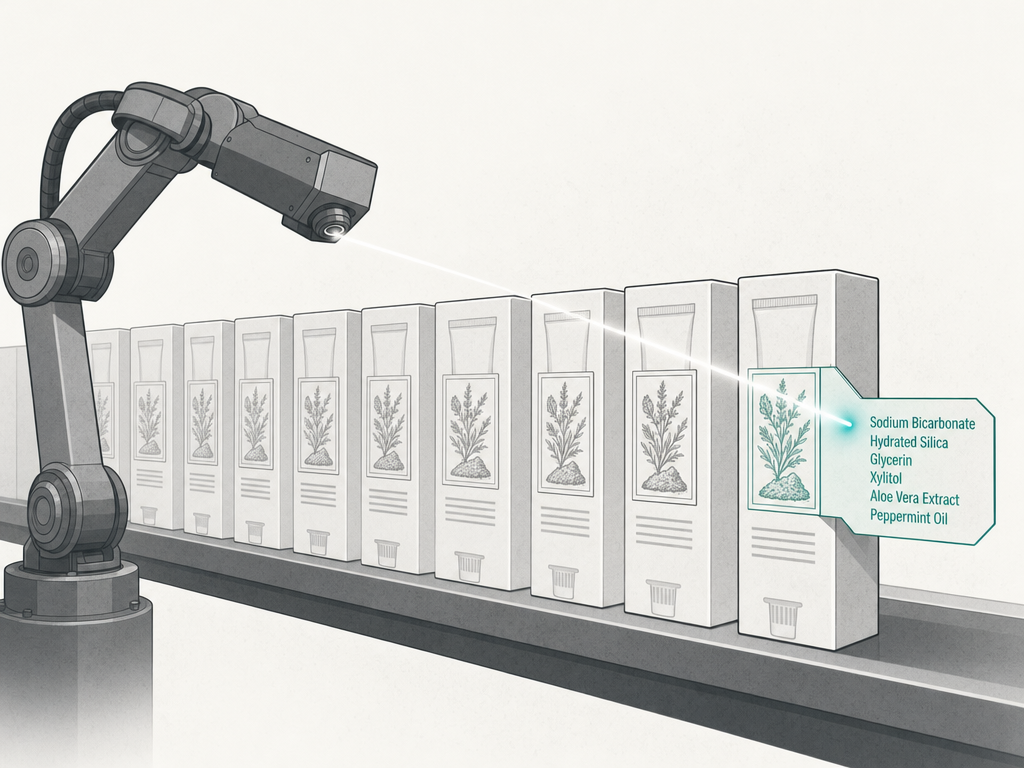

Before commissioning a paid audit, an excipient supplier should inspect four layers on its own site: functional category pages, grade and regulatory disclosure, compatibility content, and PDF dependency. These are the layers AI assistants parse when a formulator asks for a direct compression binder or a pediatric taste-masking agent. If AI cannot read what your excipient does, it cannot name you in the answer.
Why excipient suppliers face a different AI visibility problem
Excipient suppliers get matched to queries by function, not by name, which makes their visibility problem distinct from APIs or CDMOs. A formulator searches for a mechanism: a binder that survives direct compression, a superdisintegrant with fast wicking, a diluent that tolerates a moisture-sensitive drug. The AI assistant then works backward from that function to a product and from the product to a supplier.
That backward path is where excipient suppliers break. An API manufacturer can be cited by compound name. A CDMO can be cited by service and dose form. Excipient suppliers live in a middle layer where the functional need, the grade, the compendial status, and the compatibility profile all have to connect before a citation happens. This is a different problem than the one facing CDMOs and nutraceutical brands covered across the broader cluster, each of which has its own structural failure modes worth understanding separately.
The practical consequence: a polished brand site built around company story and product families can be invisible to a question phrased as "what excipient do I use for X." The naming machinery depends on function-first structure, and that is what the self-check inspects.
The queries formulators actually ask AI assistants
Formulators ask AI assistants functional and comparative questions, not branded ones. AEO Dose's audit methodology tests excipient queries across five platforms (ChatGPT, Gemini, Perplexity, Claude, Grok) and five buyer journey themes: discovery, evaluation, product and capability, commercial, and support. The queries that surface suppliers look like working formulation problems.
Typical patterns include "best direct compression binder for a high-dose tablet," "superdisintegrant comparison for orally disintegrating tablets," "taste-masking excipients for pediatric suspensions," and "multi-compendial lactose grades available in both USP-NF and Ph. Eur." Notice none of these start with a brand. They start with a function, a dose form, or a regulatory requirement.
The same question also behaves differently across platforms. One assistant may lean on a supplier's own HTML, another may weight third-party databases, another may synthesize from compendial references. That platform spread is the reason a supplier can appear in one answer and vanish in the next. The self-check prepares your content for the shared requirement underneath all five: machine-readable function, grade, and context.
Layer 1: Functional category pages, structured by what the excipient does
Check whether you have a page for each functional category, named by function and not by product line. This layer maps directly to how formulators phrase queries. If your site organizes products by brand family or chemistry but has no page titled around "direct compression binders" or "superdisintegrants," the AI has no clean target to match a functional query against.
Each functional category page should state the function in the heading, list the products that serve it, and describe the mechanism in plain prose. A page that says "our microcrystalline cellulose grades" is weaker for AEO than one that says "direct compression binders and dry binders" and then names the grades underneath. The function is the entry point; the product is the destination.
Structured markup reinforces this. Using the Schema.org vocabulary for Product and Organization, you can populate product pages with fields that let an AI engine map a grade to a category, a manufacturer, and a compendial reference. Confirm the markup is present and that the function appears in indexable text, not only inside an image or a downloadable file.
Layer 2: Grade and regulatory disclosure in plain HTML
Check that grade and compendial status appear as readable HTML text, not locked inside a PDF or an image. AI assistants cite excipients by compendial status, so if your site states "complies with USP-NF and Ph. Eur." only inside a spec sheet attachment, that trust signal may never reach the answer. Compendial references such as the United States Pharmacopeia (USP-NF) are canonical signals AI engines surface when a formulator asks for a specific grade or monograph.
Disclosure extends past your own site. AI engines pull from third-party regulatory databases, which means your DMF status is part of AEO readiness even though it sits outside your web pages. FDA Drug Master File (DMF) public listings are one such source: when an assistant answers a regulatory-filing question, it may draw on that database rather than on your marketing copy. Your self-check should note whether your filings are discoverable and whether your site references them in plain text.
The mechanism to confirm: for each grade, is the compendial status, the regulatory filing reference, and the monograph name written in text a crawler can read? When those sit only in PDFs, the citation surface shrinks to whatever the AI can extract from attachments, which is still evolving.
Layer 3: Compatibility and formulation context content
Check whether your site contains compatibility and formulation context content, because that is what lets an AI connect your excipient to a real formulation problem. A formulator asking about a moisture-sensitive API needs to know which diluents tolerate it. If your pages describe the excipient in isolation but never in the context of drug classes, dose forms, or process routes, the AI has nothing to bridge the gap between the question and your product.
This is the layer where the common assumption fails. A well-designed brand website, rich with company history and clean product imagery, is not enough for AI visibility if it never states the contexts an excipient fits. Visual polish does not create the semantic links an assistant needs. The content has to say, in words, "this grade supports direct compression of high-dose actives" or "this superdisintegrant performs in orally disintegrating tablets."
Confirm you have content that names drug compatibility considerations, dose form suitability, and process fit. This is not formulation advice to the reader; it is the connective tissue that makes your product nameable when a working query describes a context rather than a compound.
Layer 4: PDF dependency and what to move into web pages
Check how much of your technical data lives only in PDFs, because PDF-only spec sheets are a current AEO risk. Most excipient spec sheets are published as PDFs, which is reasonable for regulatory and archival reasons. The problem is that AI assistants' handling of PDF content is still developing, so data buried in an attachment may not reach an answer the way the same data in HTML would.
The fix is not to delete the PDFs. It is to mirror the data that matters for discovery into indexable web pages. Grade names, compendial status, functional categories, particle size ranges, and compatibility notes should exist as HTML text on a product or category page, with the PDF available as the authoritative download underneath.
Run the mechanism check: pick one grade and ask whether a crawler reading only your HTML would learn its function, its compendial status, and its typical application. If the answer is no, and the data lives only in the attached PDF, that grade is exposed to the current PDF limitation. Moving the discovery-relevant fields into the page closes that gap.
What the self-check cannot tell you, and when a Free AI Visibility Check adds value
The self-check tells you whether your content is structured for AI to read; it cannot tell you what the AI actually says about you today. You can confirm your functional category pages exist, your grades are in HTML, your compatibility content is present, and your PDFs are mirrored. What you cannot see from inside your own site is how ChatGPT, Gemini, Perplexity, Claude, and Grok respond right now when a formulator asks for a binder or a superdisintegrant, and whether a competitor appears where you do not.
That platform-level picture is the signal that the self-check is not enough. If you have fixed the four layers and still want to know who gets named, across which platforms, for which queries, that requires querying the platforms directly and comparing results.
First thing Monday: open one functional category your business serves, and read your own category page as if you were an AI with no prior knowledge of your brand. If you cannot tell what the excipient does, what grade it is, and what it is compatible with from the HTML alone, start there. Then, to see what the platforms say back, Get Your Free AI Visibility Check for the platform-level data the self-check cannot produce.