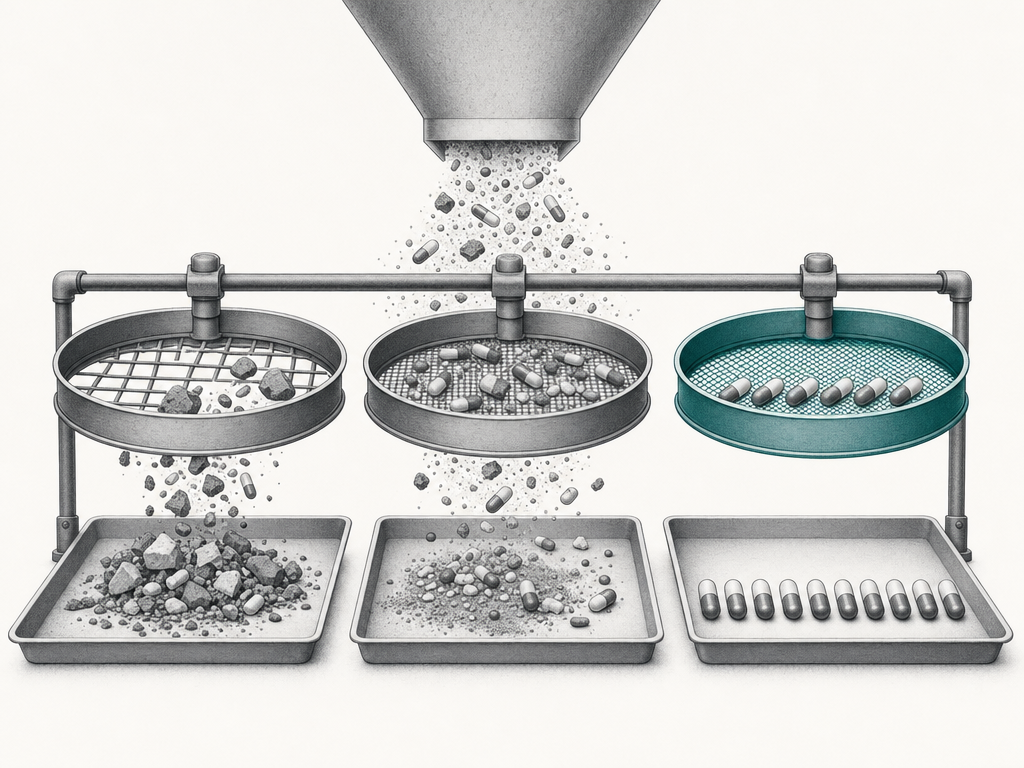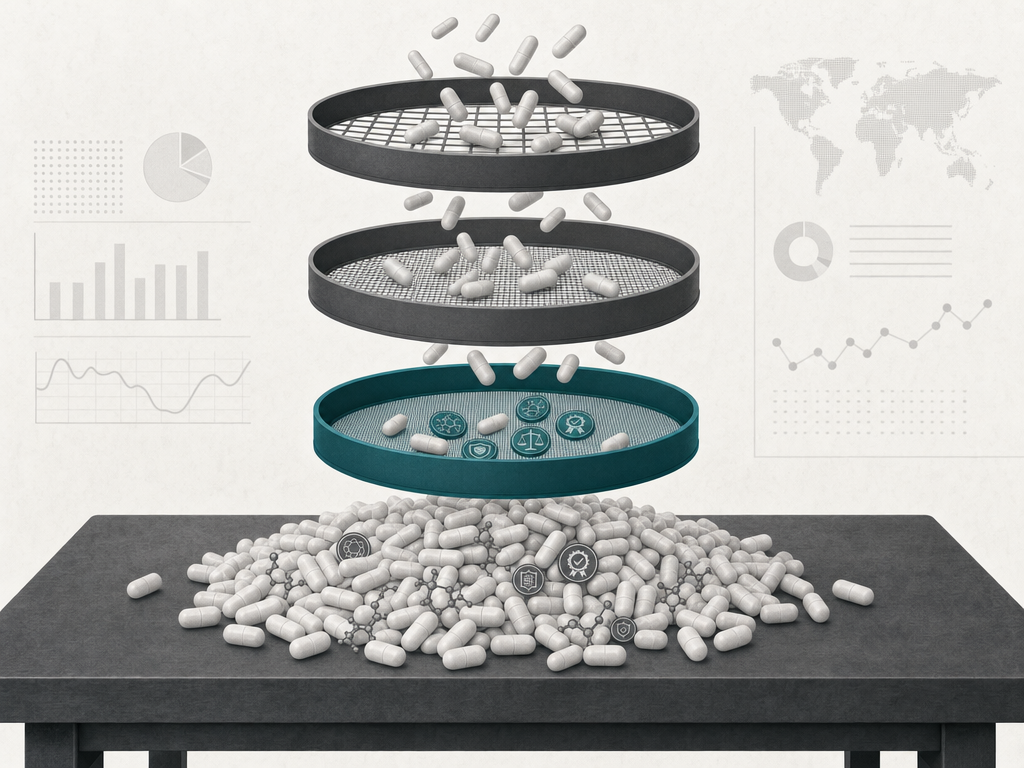
What AI visibility assessment options exist for pharma suppliers? Three categories exist: DIY prompt testing, generalist AI visibility SaaS, and specialist industry audit. The falsifiable position in this article is blunt: when pharma buyers depend on citation accuracy around regulatory posture, dosage form capability, and GMP context, only the specialist industry audit becomes actionable rather than ornamental.
Disclosure: this article is published by AEO Dose, which offers one of the services discussed below (a specialist pharma AEO assessment). The categories described are the real shape of the market, and AEO Dose fits inside one of them. Naming that relationship up front so readers can weigh the framing with that context in mind.
What an AI visibility assessment is actually measuring
An AI visibility assessment measures whether AI assistants mention, describe, compare, cite, or omit your company when a buyer asks supplier-selection questions. For a pharma supplier, that is not the same as checking whether your website ranks for a keyword.
The practical question is: if a buyer asks ChatGPT, Gemini, Perplexity, Claude, or Grok for API manufacturers, CDMOs, excipient suppliers, nutraceutical brands, or oral care manufacturers with a particular capability, does your business appear in the answer, and is the description correct?
A useful assessment should look at four things:
- Presence: whether the company appears at all.
- Positioning: how the company is described against the buyer's need.
- Citation accuracy: whether the answer supports claims with credible sources.
- Gap diagnosis: why competitors, directories, distributors, or irrelevant companies appear instead.
If you are still grounding the basics of AI visibility and AEO, the Understanding AI Visibility and AEO cluster is a useful starting point before buying a tool or audit. Without that grounding, a visibility score can look more precise than it is.
The pharma-specific issue is accuracy. A CDMO cannot treat a wrong formulation capability, wrong dosage form, or vague GMP statement as a minor branding issue. The output can mislead buyers before a sales conversation ever starts.
The three categories of assessment available right now
The assessment market separates into three categories: DIY prompt testing, generalist AI visibility SaaS, and specialist industry audit. Each category answers a different question, and each stops working at a different point.
Here is the clean map:
| Category | What it answers | Where it helps | Where it stops for pharma |
|---|---|---|---|
| DIY prompt testing | "Do we show up when I ask common questions?" | When you need a quick directional view | It does not explain the evidence layer, prompt design gaps, or citation accuracy in a controlled way |
| Generalist AI visibility SaaS | "Are we being mentioned across tracked prompts and engines?" | When you need dashboards, trend views, and broad monitoring | It may not understand regulatory posture, dosage form nuance, GMP context, or pharma buyer intent |
| Specialist pharma AEO audit | "Are buyers seeing us accurately for the questions that drive commercial decisions?" | When citation accuracy, capability fit, and action planning matter | It requires more manual interpretation than a generic dashboard |
This is not a product review. It is a category map. Scores and dashboards are not assessments, and a buyer who treats them as such will act on bad signal. A score can tell you something was detected. It does not, by itself, tell you whether the answer is commercially useful, technically accurate, or fixable.
Category one: DIY prompt testing (what you can learn in an afternoon and where it stops)
DIY prompt testing can show whether your company appears in obvious buyer questions, but it cannot by itself produce a controlled diagnosis. It is a sensible first pass when budget is not approved or when you want to understand the problem before speaking to a vendor.
A pharma marketing or business development lead can start with 10 real buyer questions across two platforms. For example:
- "Which CDMOs manufacture solid oral dosage forms for regulated markets?"
- "What excipient suppliers support direct compression tablet formulations?"
- "Which API manufacturers have experience with controlled substances?"
- "Compare nutraceutical contract manufacturers for capsule and powder formats."
- "Which oral care product manufacturers support private label toothpaste?"
Run the same question in two systems, such as ChatGPT and Perplexity, and capture the answer, cited sources, missing competitors, false statements, and wording used to describe your company.
The value is immediate: you will see whether AI assistants can connect your business with the capability you sell. The stop point is also immediate. DIY checks are unstable when prompts are vague, when the same user rewrites questions differently, or when no one separates discovery questions from evaluation questions. They also do not tell you which website, third-party source, structured content, or authority gap caused the answer.
Use DIY testing to decide whether there is a visible issue. Do not use it as the final assessment for budget allocation.
Category two: generalist AI visibility SaaS tools (what the dashboards do and where they fall short for pharma)
Generalist AI visibility SaaS tools turn repeated prompt testing into dashboards, but the dashboard view can miss the pharma-specific reason a result is commercially wrong. Their value is monitoring: tracked prompts, engine comparisons, brand mention capture, sentiment-style summaries, and periodic reporting.
That is useful when the business needs a broad view across many queries. It is also useful for teams that need trend lines instead of screenshots. A dashboard can help a marketing team see whether a company is being mentioned across selected prompts, whether competitors appear in the same answer, and whether citations point to owned or third-party sources.
The pharma gap is interpretation. A generalist system may register a mention as positive even when the answer confuses development services with commercial manufacturing, states a capability that the company does not offer, or fails to distinguish GMP manufacturing from wellness-brand positioning. For CDMOs, API manufacturers, excipient suppliers, nutraceutical brands, and oral care manufacturers, those distinctions affect buyer trust.
This is where industry context matters. The Industry-Specific Visibility Challenges cluster is useful for readers who need to separate general AI visibility from the specific visibility problems faced by pharma and healthcare suppliers.
Generalist dashboards can also flatten buyer intent. A discovery prompt such as "find CDMOs for tablets" is different from an evaluation prompt such as "compare CDMOs with high-potency solid dose experience." A tool that treats both as generic brand visibility may give a neat score while hiding the commercial issue.
Category three: specialist pharma AEO audits (what buyer-journey prompts and ranked findings deliver)
A specialist pharma AEO audit tests whether AI assistants answer real buyer-journey questions with accurate, source-supported descriptions of your company. It is built for diagnosis, not decoration.
At AEO Dose, the Free AI Visibility Check covers 2 platforms and 10 real buyer questions. The Full AI Visibility and AEO Readiness Audit covers all 5 current platforms: ChatGPT, Gemini, Perplexity, Claude, and Grok. The questions are built from five buyer journey themes: discovery, evaluation, product/capability, commercial, and support.
That structure matters because pharma buyers do not ask only one kind of question. A procurement or BD conversation may begin with supplier discovery, move into technical evaluation, narrow around product or capability fit, ask commercial questions, and then look for support signals. If your company appears in discovery but disappears during capability evaluation, a single score will not show enough.
A specialist audit should also test whether the answer is accurate against pharma reality. That means checking how AI systems describe regulatory posture, dosage form capability, GMP context, manufacturing scope, and the evidence used to support the answer. M Netrajit Singha's background as a B.Pharma graduate with 12+ years of Pharma ERP implementation and Computer System Validation experience informs that review lens: the assessment is not only asking whether the brand appeared, but whether the answer would survive a serious buyer conversation.
The output should include ranked findings by impact and effort, not a raw dump of screenshots. It should also connect the findings to an operating cycle: Audit, Optimize, Build Authority, Measure, Repeat. Readers who want that process view can use the Audit and Optimization Process cluster as the next layer.
How to decide which category fits your business right now
The right category depends on the decision you need to make after the assessment. Start with the business question, not the tool category.
Choose DIY prompt testing when you need a fast, low-cost signal and no one has yet checked whether your company appears in AI answers. This fits an early internal discussion: "Do we have a problem worth investigating?" Keep the test small, document the prompts, and avoid turning screenshots into strategy.
Choose generalist AI visibility SaaS when you need ongoing monitoring across a wider prompt set and your team can interpret the outputs with pharma context. This fits teams that already know their priority prompts and want a dashboard layer for repeated measurement.
Choose specialist pharma AEO audit when the risk is not only visibility but accuracy. This fits a CDMO, API manufacturer, excipient supplier, nutraceutical brand, or oral care manufacturer that needs to know why buyers see competitors, why citations point elsewhere, and which changes are worth making first.
The practical decision rule is simple: if the next action is "show leadership that AI visibility is worth attention," DIY can work. If the next action is "track known prompts over time," a dashboard may fit. If the next action is "fix inaccurate or missing supplier positioning in buyer-facing AI answers," use a specialist audit.
What any assessment should deliver beyond a score, and how often to repeat it
Any useful assessment should deliver evidence, diagnosis, and next actions beyond a visibility score. A number without prompt context, answer text, citation review, and remediation priority is not enough for a pharma supplier.
Look for these deliverables:
- The exact prompts tested.
- The platforms tested.
- The answers captured.
- Whether your company appeared, was omitted, or was misdescribed.
- Which competitors or alternate suppliers appeared.
- Which sources were cited.
- Which claims were unsupported or inaccurate.
- What content, entity, citation, or authority gaps explain the result.
- A ranked action list by impact and effort.
Repeat the assessment after material changes. That can include website restructuring, new capability pages, new third-party citations, new case studies, regulatory or facility changes, or a completed optimization cycle. The useful operating rhythm is not "check once and forget." It is Audit, Optimize, Build Authority, Measure, Repeat.
For a pharma business, that repeat cycle matters because AI answers are not static. Engines change, source sets shift, and competitor evidence changes. The assessment should give your team a way to see whether the information environment around your company is becoming clearer, not just whether a score moved.
This week, run 10 real buyer questions across two platforms and capture the exact answers before buying anything. If that first pass shows omissions, wrong capability descriptions, or weak citations, use it to decide whether you need a dashboard layer or a specialist pharma AEO audit. One entry point is here: Get Your Free AI Visibility Check