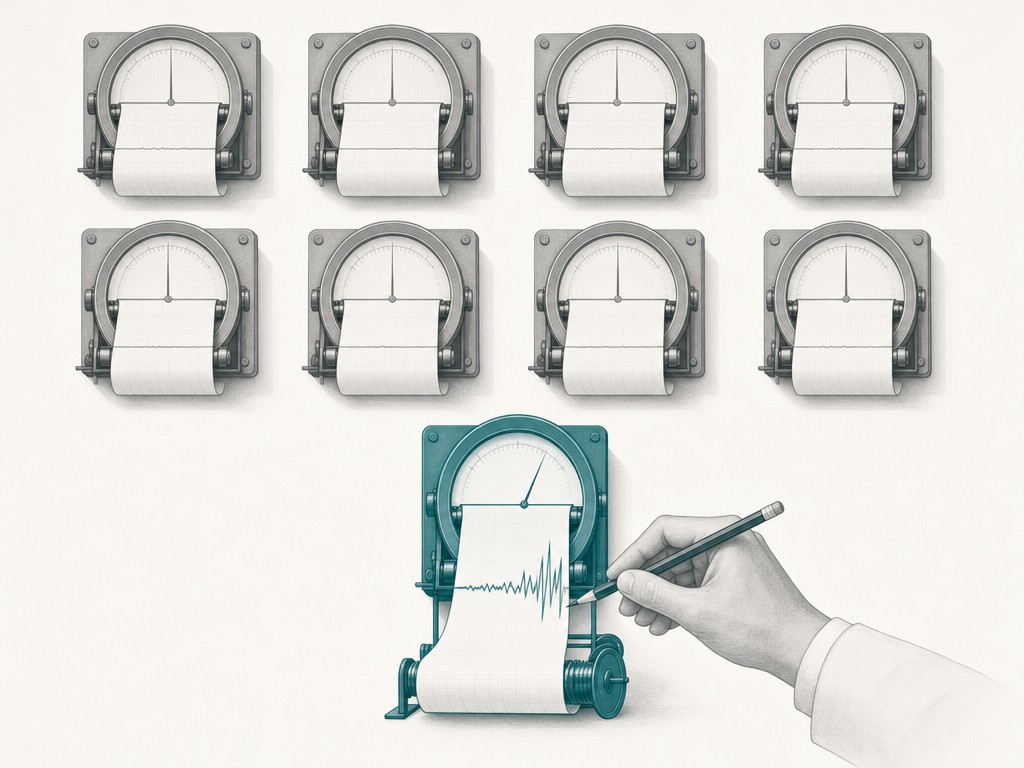
AI visibility optimization companies offer follow-up work that centers on re-measurement, competitor re-benchmarking, and iterative content and schema optimization, because AI assistant answers drift as models retrain and as buyer phrasing changes. This is the Audit, Optimize, Build Authority, Measure, Repeat cycle in practice. The first audit is a starting point, not a finished deliverable. This article explains what each stage of follow-up work covers and when it is worth running.
- Why AI assistant answers drift after the first audit
- What re-measurement across five platforms actually involves
- How the Audit, Optimize, Build Authority, Measure, Repeat cycle runs
- How follow-up work catches competitor citation shifts
- How coverage expands into new buyer journey themes over time
- What deliverables a pharma buyer should expect from follow-up
- When re-measurement is worth the cost and when it is not
Why AI visibility changes after the initial audit
AI visibility changes after the initial audit because the systems that produce the answers do not sit still. The large models behind ChatGPT, Gemini, Perplexity, Claude, and Grok update on rolling release cycles through 2025 and 2026. When a model retrains, the sources it draws on and the phrasing it favors can move. OpenAI publishes model release notes documentation that records these updates as a regular cadence, and Anthropic's model release documentation does the same on a separate schedule. Each platform updates independently, which means a result you verified on one assistant can read differently on another after a model update.
Here is the direct pushback against the one-shot audit model. An audit sold as a single deliverable describes a moment. It does not account for two mechanisms that operate continuously: model retraining and buyer phrasing drift. A CDMO buyer who searched "contract manufacturer for sterile injectables" last quarter may phrase the same need as "sterile fill-finish CDMO" this quarter. If your visibility was measured only against the first phrasing, your report is already partly out of date. This is not a flaw in the audit. It is the nature of the medium.
What re-measurement actually looks like across five platforms
Re-measurement means re-running the same buyer questions across ChatGPT, Gemini, Perplexity, Claude, and Grok and comparing the new results against the baseline. Five-platform coverage is the current operating standard because the platforms do not move in step. A result that held on Perplexity can shift on Claude after an unrelated update. Testing one assistant and assuming the others behave the same way produces a false reading.
Re-measurement is structured, not casual. The questions are drawn from the five buyer journey themes: discovery, evaluation, product and capability, commercial, and support. Each theme carries its own set of buyer phrasings. Discovery questions ask who exists in a category. Evaluation questions compare named suppliers. Product and capability questions probe specific technical claims. Commercial questions touch pricing posture and terms. Support questions test post-sale service signals. Re-measuring across all five themes shows where visibility held, where it slipped, and where a competitor moved into an answer you previously occupied.
The output is a comparison, not a fresh snapshot. You want to see the delta between the baseline and the current state, platform by platform and theme by theme. That delta is the thing follow-up work acts on.
The Audit, Optimize, Build Authority, Measure, Repeat cycle in practice
The cycle runs in five stages that feed each other, and follow-up work lives in the back four. Audit establishes the baseline: how you appear across the five platforms and five buyer journey themes today. Optimize acts on the gaps the audit found, through content and schema changes that make your information easier for AI systems to parse and attribute. Build Authority works on the signals outside your own pages: the third-party sources, directories, and references that models treat as corroboration. Measure re-runs the questions to see what moved. Repeat takes the measurement findings and sets the next round of optimization.
Content and schema optimization are the controllable stages of the loop. Content optimization clarifies your capability claims so an assistant can state them cleanly. Schema optimization structures that information so the system can read and attribute it without guessing. Neither is a one-time fix. When a model retrains or a buyer journey theme shifts, the content and schema that worked may need another pass. Build Authority runs on a different cadence because third-party signals accumulate over time rather than switching on.
The point of naming the stages is to show that follow-up work is not open-ended retainer activity. It is a defined loop with a measurable output at the Measure stage each time around.
How follow-up work addresses competitor citation shifts
Follow-up work addresses competitor citation shifts by re-benchmarking who appears in the answers alongside you, not just whether you appear. A one-time audit tells you your own position. It does not tell you that an excipient supplier who was absent from evaluation-theme answers in one quarter now appears in them the next. That movement is competitive intelligence, and it only shows up if you re-measure against the same questions over time.
Competitor re-benchmarking works because AI answers are comparative by construction. When a buyer asks an assistant to recommend or compare suppliers, the answer lists several names. Your visibility is relative to the other names in that list. If a competitor improves its content and schema, or accumulates third-party references, it can enter answers it previously missed, which pushes someone else out. Re-benchmarking catches that shift while it is still actionable rather than after you have already lost discovery-theme presence without noticing.
The follow-up deliverable here is a tracked comparison: which competitors entered or left answers, on which platforms, under which buyer journey themes. That tells you where to direct the next optimization pass.
Expanding into new buyer journey themes over time
Follow-up work expands into new buyer journey themes over time as earlier themes stabilize and new buyer questions surface. An initial engagement may concentrate on discovery and evaluation, because that is where a supplier first needs to be found and compared. Once those hold, attention can move to product and capability, commercial, and support, where buyers ask about specific technical, commercial, and post-sale concerns.
This expansion is driven by how buyers actually move. A buyer who found you in a discovery answer later asks an assistant about your specific capabilities, then about commercial terms, then about post-sale support. Each of those questions lives in a different theme and demands different content and schema signals. A nutraceutical brand might need capability-theme work on ingredient sourcing claims, while an oral care manufacturer might need support-theme work on regulatory documentation. The themes do not expand all at once. They expand as the buyer journey reveals which questions matter next for a given supplier.
What a pharma buyer should expect from a follow-up engagement
A pharma buyer should expect a follow-up engagement to deliver a re-measurement comparison, a competitor re-benchmark, and a prioritized list of content and schema changes tied to specific gaps. The deliverable is evidence-based, not aspirational. You should be able to read it and see exactly which answers moved, which competitors shifted, and which fixes the next round recommends.
Support models beyond the initial audit vary by how much of the cycle a buyer wants to run and how often. One option is to run the full Audit, Optimize, Build Authority, Measure, Repeat loop on a set cadence. Another option is to run re-measurement only and handle optimization internally. Choosing between these depends on internal capacity and how fast your category moves. The wider question of how to structure that support is covered in the Getting Support for AI Visibility pillar, which walks through choosing a partner and when to escalate from a free check to a full engagement.
What a follow-up engagement should not be is an open-ended retainer with no measurable output. Each round should end at the Measure stage with a comparison you can act on.
When re-measurement is worth it and when it is not
Re-measurement is worth it when your category is active and your visibility affects buyer discovery. If you operate in a category where AI assistants recommend and compare suppliers, and where a competitor entering an answer costs you inbound interest, re-measurement earns its place. If your buyers do not yet use AI assistants to shortlist suppliers, the cadence can match that lower stakes.
Two triggers justify a re-measurement outside any fixed schedule. The first is a known model update across one of the five platforms, because a retrain can move results independent of anything you did. The second is a competitive event, such as a competitor launching new capability content, because that can change who appears in evaluation-theme answers. In the absence of ongoing measurement, both shifts stay invisible until they have already cost you position.
For a practical next step this quarter: decide a re-measurement cadence tied to your category's pace, then pick the two buyer journey themes where losing an answer would cost you the most, and scope the next round around those. If you want a baseline to measure against first, Get Your Free AI Visibility Check.